
Fluxional catalytic interfaces, ensembles of metastable states
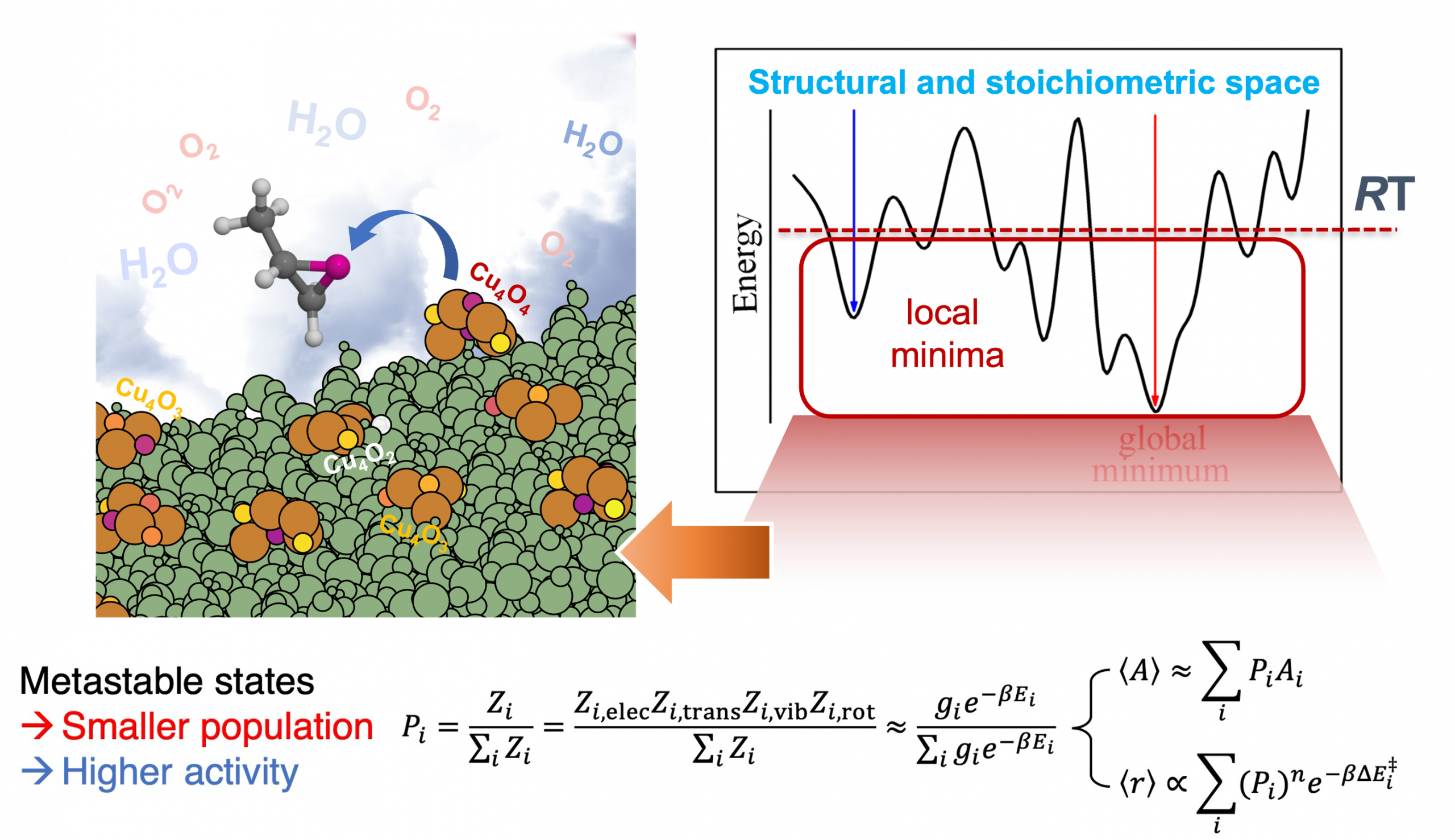
Our team invented the concept of ensembles of catalytic states that catalytic interfaces may access in reaction conditions. When conditions are harsh, many distinct free energy minima (different in structure and stoichiometry/coverage) are thermally accessible by the interface. As a result, all properties of the interface are those of an ensemble, meaning that many co-existing catalyst states contribute to activity, selectivity, deactivation, and operando spectral signatures. Rare, metastable states can be driving all the catalysis while the most stable forms can be spectators. Catalytic ensembles evolve together with the reaction, and can push the system off thermodynamic equilibrium. Scaling relations routinely break down. Multiple reaction profiles, not one, make the catalyst. Since 2014, when this concept, and tools were developed in our group, it has been named also as collectivity effect in catalysis, which is the same thing.
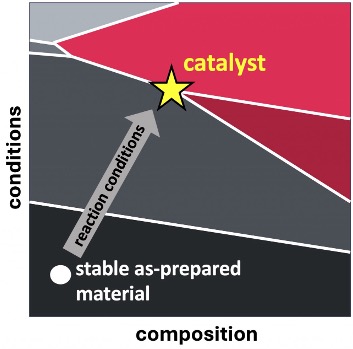
We also recently came to a realization that best catalysts are not single phases of matter, but boundaries between several phases, where stoichiometric changes are effectively energetically free, but sampling diverges by definition, and quasi-equilibrium prevails.
Key Publications:
Ha, M.-A.; Dadras, J.; Alexandrova, A. N.* Rutile-deposited Pt-Pd clusters: a hypothesis regarding the stability at 50/50 ratio. 2014, ACS Catal., 4, 3570-3580. Download
Zhai, H.; Alexandrova, A. N. Ensemble-Average Representation of Pt Clusters in Conditions of Catalysis Accessed through GPU Accelerated Deep Neural Network Fitting Global Optimization. 2016, J. Chem. Theor. Comput., 12, 6213-6226. Download
Baxter, E. T.; Ha, M.-A.; Cass, A. C.; Alexandrova, A. N.; Anderson, S. L. Ethylene Dehydrogenation on Pt4,7,8 clusters on Al2O3: Strong Cluster-Size Dependence Linked to Preferred Catalyst Morphologies. 2017, ACS Catal., 7, 3322-3335. Download
Ha, M.-A.; Baxter, E. T.; Cass, A. C.; Anderson, S. L.; Alexandrova, A. N. Boron Switch for Selectivity of Catalytic Dehydrogention on Size-Selected Pt Clusters on Al2O3. 2017, J. Am. Chem. Soc., 139, 11568-11575. Download
Zhai, H.; Alexandrova, A. N. Local Fluxionality of Surface-Deposited Cluster Catalysts: the Case of Pt7 on Al2O3. 2018, J. Phys. Chem. Lett., 9, 1696-1702. Download
Halder, A.; Ha, M.-A.; Zhai, H.; Alexandrova, A. N.; Vajda, S. Oxidative Dehydrogenation of Cyclohexane on Pd vs. Cu Clusters: Selectivity Control by Specific Cluster Dynamics. 2020, ChemCatChem, 12, 1307-1315. Download
Venegas, J.; Zhang, Z.; Agbi, T.; McDermott, W.; Alexandrova, A. N.; Hermans, I. Why Boron Nitride is such a Selective Catalyst for the Oxidative Dehydrogenaiton of Propane. 2020, Angew. Chem. Int. Ed., VIP article, 14, 16527-16535. Download
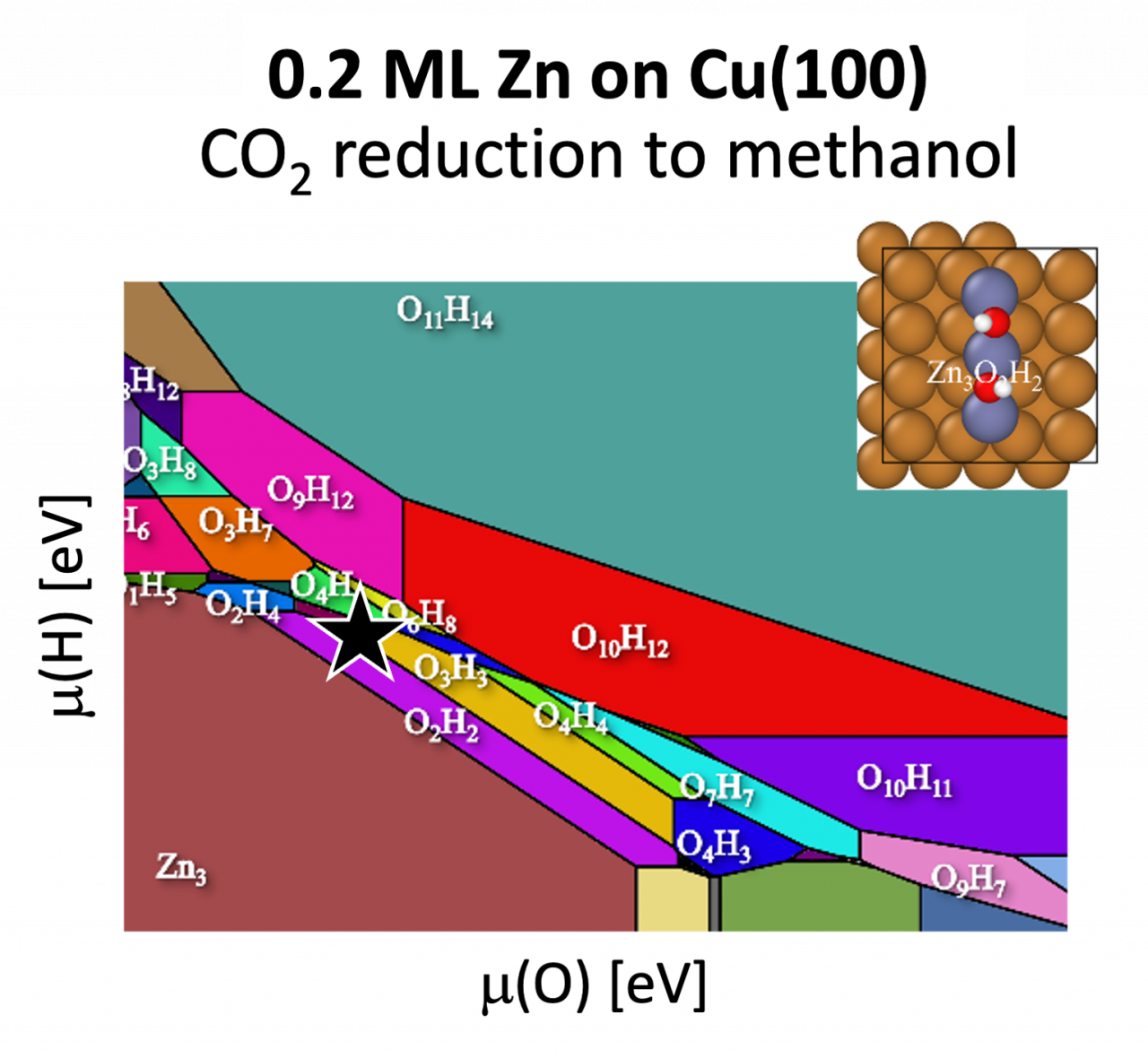
Lavroff, R. H.; Cummings, E.; Sawant, K.; Zhang, Z.; Sautet, P.; Alexandrova, A. N. Cu-supported ZnO in Conditions of CO2 Reduction to Methanol: Why 0.2 ML Coverage? 2024, J. Phys. Chem. Lett., 15, 11745-11752. Download
Key concepts and reviews:
Zhai, H.; Alexandrova, A. N. Fluxionality of Catalytic Clusters: When It Matters and How to Address It. 2017, ACS Catal, 7, 1905-1911. Download
Zandkarimi, B.; Alexandrova, A. N. Surface-supported cluster catalysis: ensembles of metastable states run the show. 2019, WIRES, advanced review, DOI: 10.1002/wcms.1420. Download
Zhang, Z.; Zandkarimi, B.; Alexandrova, A. N. Ensembles of metastable states govern heterogeneous catalysis on dynamic interfaces. 2020, Acc. Chem. Res., 53, 447-458. Download
Prajapati, A.; Hahn, C.; Weidinger, I.; Shi, Y.; Lee, Y.; Alexandrova, A. N.; Thompson, D.; Bare, S. R.; Chen, S.; Yan, S.; Kornienko, N. Best Practices for In-Situ and Operando Techniques within Heterogeneous Catalytic Systems. 2025, Nat. Comm., 16, 2593. Download
Alexandrova, A. N.; Christopher, P. Heterogeneous catalysis: Optimal performance at a phase boundary? 2025, Matter, 102209. Download
Methods and software
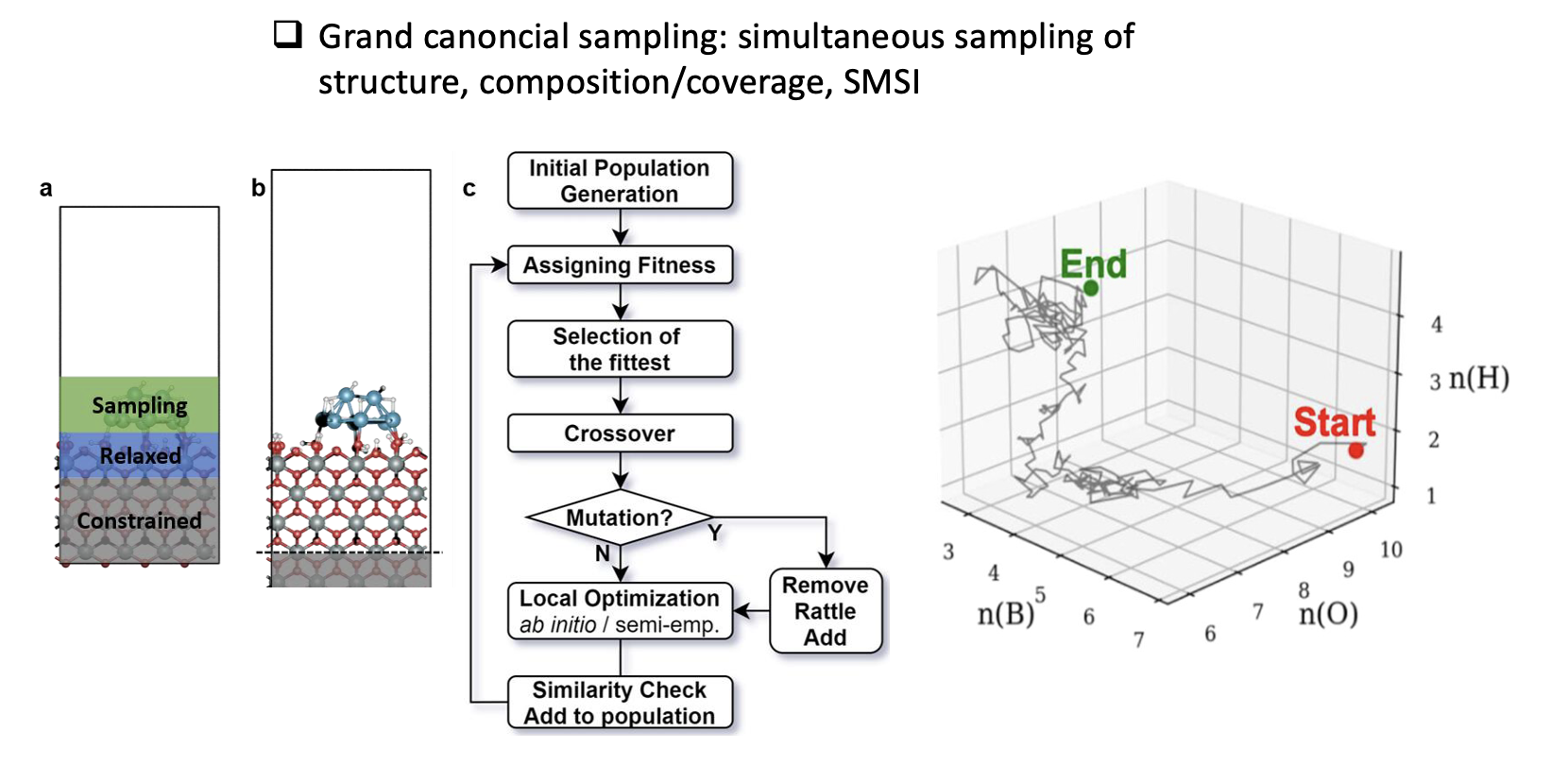
We develop methods for realistic grand canonical treatment of catalytic interfaces and electrodes directly under the relevant reaction conditions, i.e. temperatures, pressures and concentrations of the reactants, catalytic conversion, and electrochemical potential. Grant canonical genetic algorithm, GCGA, implemented in our code, GOCIA, is one example. We sample the interfacial structure together with its stoichiometry and coverage, thereby finding the status of the interface at any desired conditions. The results of such simulations include the steady-state status of the catalytic material, practically relevant phase diagrams that include dynamism of interfaces that are particularly fluxional, and access to metastable state that the system can thermally access in reaction conditions to drive the reaction mechanism, rate, selectivity, and catalyst deactivation propensity. The sampling also closely links to operando spectroscopy, where the experiment typically measures an ensemble-averaged signal, and theory contributes a species-resolved interpretation as well we helps identifying minority sites that can be catalytically relevant.
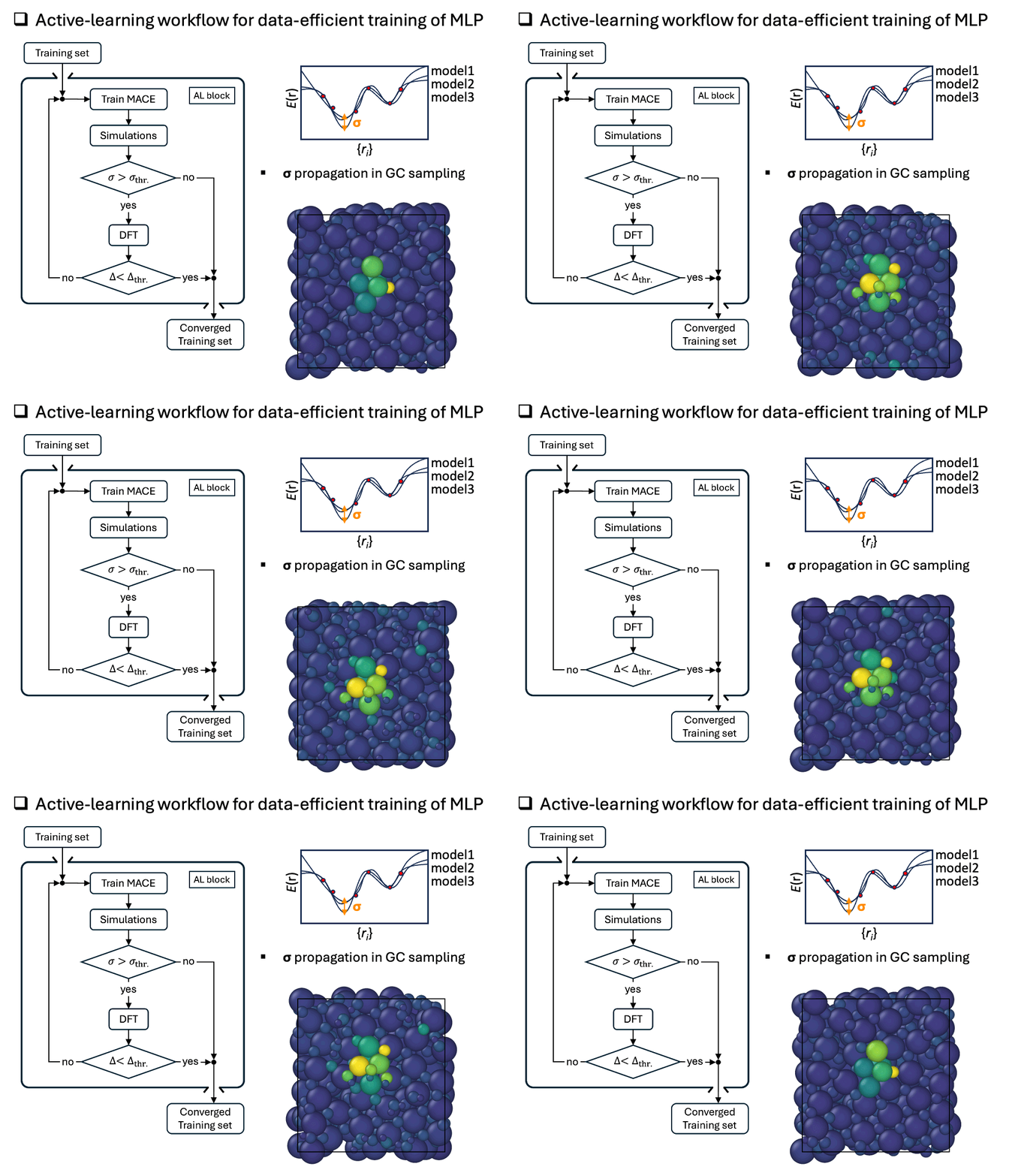
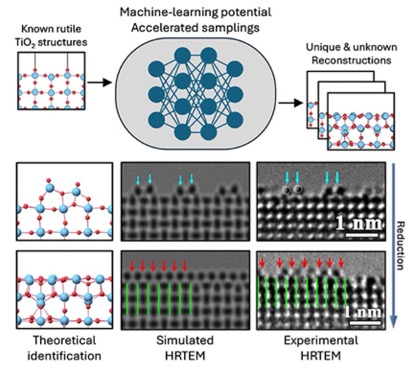
The sampling can be accelerated by machine learning interatomic potentials, where we have an active learning workflow, whereby the data obtained in sampling is constantly used to refine the potential to match the DFT accuracy. Larger scale reconstructions can be accessed with the combination of GCGA and MLPs.
A frontier direction in our work is the role of kinetic effects, phase boundaries, and nonequilibrium/quasi-equilibrium states in defining the structure and stoichiometry of the working interface.
Key Publications:
Alexandrova, A. N.; Boldyrev, A. I. Search for the Lix0/+1/-1 Lowest Energy Structures Using Ab Initio Gradient Embedded Genetic Algorithm (GEGA). Elucidation of the Chemical Bonding in the Lithium Clusters. J. Chem. Theory Comput., 1, 566, 2005. Download
Wan, C.; Zhang, Z.; Dong, J.; Xu, M.; Pu, H.; Baumann, D.; Lin, Z.; Wang, S.; Huang, J.; Shah, A. H.; Pan, X.; Hu, T.; Alexandrova, A. N.; Huang, Y.; Duan, X. Amorphous nickel hydroxide shell tailors local chemical environment on platinum surface for alkaline hydrogen evolution reactio. 2023, Nature Mater., DOI: 10.1038/s41563-023-01584-3. Download
Zhang, Z.; Gee, W.; Lavroff, R. H.; Alexandrova, A. N. GOCIA: Global Optimizer for Clusters, Interfaces, and Adsorbates. 2025, Phys. Chem. Chem. Phys., 27, 696-706. Download
Lee, Y.; Chen, X.; Gericke, S.; Li, M.; Zakharov, D.; Head, A.; Yang, J.; Alexandrova, A. N. Machine-Learning-Driven Exploration of Surface Reconstructions of Reduced Rutile TiO2. 2025, Angew. Chem. Int. Ed., 64, e202501017 Download.
Zhang, Z.; Hermans, I.; Alexandrova, A. N. Off-stoichiometric Restructuring and Sliding Dynamics of Hexagonal Boron Nitride Edges in Conditions of Oxidative Dehydrogenation of Propane. 2023, J. Am. Chem. Soc., 145, 17265-17273. Download.
Poths, P.; Vargas, S.; Sautet, P.; Alexandrova, A. N. Thermodynamic equilibrium versus kinetic trapping: thermalization of cluster catalyst ensembles can extend beyond reaction timescales. 2024, ACS Catal., 14, 5403-5415. Download
https://github.com/zishengz/gocia
Electrocatalysis
With the availability of renewable electricity, electrocatalysis gives access to a variety of catalytic processes of interest to humankind. We are focus on such electrocatalytic processes as CO2 reduction, reactive capture to close the carbon cycle and recover fuels, hydrogen evolution, oxygen reduction useful in fuel cells, and more.
We use grand canonical theoretical approaches to reveal the structure and composition of the interface under the presence of solvent, electrolyte, electrochemical potential, pH, and pressures of gasses. We develop new electrode materials. We also study the effect of the electrolyte composition as a particularly important aspect governing the interface and its catalytic functionality, as well as corrosion mechanisms and rates. Collaborations with many experimental groups, performing electrochemical measurements, and in situ spectroscopy and microscopy, are prominent.
This directions features frontier fundamental aspects of interfacial chemistry and chemical physics, including off-equilibrium behavior, role of phase transitions in making a catalyst catalytic, and more.
Key Publications:
Brower, R. S.; Wuille Bille, B.; Chiu, S.; Perryman, J. T.; Yao, L.; Agboola, F.; Nagasaka, C. A.; Xie, Y.; Gomez, R.; Kumari, A.; Neumann, E.; Alexandrova, A. N.; McCrory, C. C. L.; Velázquez, J. M. Selective Electrochemical Reduction of CO2 to Oxalate in Non-Aqueous Solutions using Trace Metal Pb on Carbon Supports Enhanced by a Tailored Microenvironment. 2025, Adv. Energy Mater., DOI: 10.1002/aenm.202501286 Download.
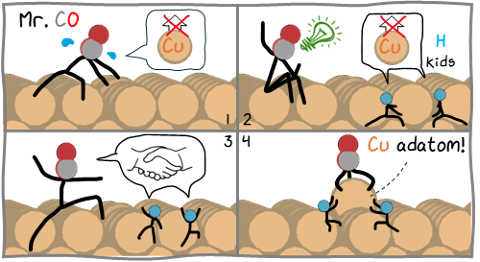
Zhang, Z.; Gee, W.; Sautet, P; Alexandrova, A. N. H and CO Co-induced Surface Roughening on Cu in CO2 Electroreduction Conditions. 2024, J. Am. Chem. Soc., 146, 16119-16127. Download
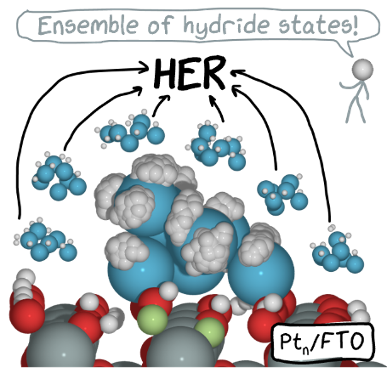
Zhang, Z.; Masubuchi, T.; Sautet, P.; Anderson, S. L.; Alexandrova, A. N. Hydrogen Evolution on FTO-Supported Ptn Clusters: Ensemble of Hydride States Governs the Size Dependent Reactivity. 2023, Angew. Chem. Int. Ed., 62, e2-2218210. Download, ChemRxiv
Munarriz, J.; Zhang, Z.; Sautet, P.; Alexandrova, A. N. Graphite-supported Ptn Cluster Electrocatalysts: Major Change of Active Sites as a Function of the Applied Potential. 2022, ACS Catal., 12, 14517-14526. Download. ArXiv
Shah, A. H.; Zhang, Z.; Huang, Z.; Wang, S.; Zhong, G.; Wan, G.; Alexandrova, A. N.; Huang, Y.; Duan, X. Unriddling the role of alkali metal cations and Pt-surface hydroxide in alkaline hydrogen evolution reaction. 2022, Nature Catal., 5, 923-933. Download
Wan, C.; Zhang, Z.; Dong, J.; Xu, M.; Pu, H.; Baumann, D.; Lin, Z.; Wang, S.; Huang, J.; Shah, A. H.; Pan, X.; Hu, T.; Alexandrova, A. N.; Huang, Y.; Duan, X. Amorphous nickel hydroxide shell tailors local chemical environment on platinum surface for alkaline hydrogen evolution reactio. 2023, Nature Mater., DOI: 10.1038/s41563-023-01584-3. Download
Cheng, D.; Nguyen, K.-L. C.; Sumaria, V.; Wei Z.; Zhang, Z.; Gee, W.; Li, Y.; Morales-Guio, C. G.; Heyde, M.; Roldan Cuenya, B.; Alexandrova, A. N.; Sautet, P. Structure Sensitivity and Catalyst Restructuring for CO2 Electro-reduction on Copper. 2025, Nat. Comm., 16, 4064 Download.
Mir, A.; Banerjee, A.; Ihiri, F.; Chiu, S.; Alexandrova, A. N.; Morales-Guio, C.; Yang, J. Optimizing CO2-Loaded Aqueous Amine Solutions for Higher Electrocatalytic CO2 Reduction Activity. 2025, J. Am. Chem. Soc., 147, 43, 39123–39133.
Thermal Catalysis
Thermal catalysis continues to be a workhorse of chemical industry, as way to perform energy-efficient transformations to make value-added chemicals, materials, fuels, and fertilizers, out of small molecules such as N2, CO, H2, and CO2.
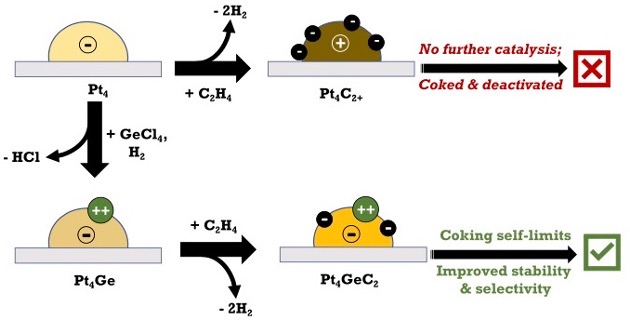
This research direction features both highly-applied aspects, and fundamental aspects of interfacial science. We study CO2 hydrogenation to methanol, dehydrogenation reactions, reverse water-gas shift, and others. We also have a big emphasis on catalyst stability over time, and mechanisms that drive degradation such as coking and sintering, and develop prevention strategies through catalyst compositional modifications and altering the support and well as metal-support interactions. The direction features strong ties to experimental groups around the world.
The methods used here are grand canonical sampling techniques that give us a competitive edge, and machine learning potentials for acceleration. We also couple to machine learning efforts that predict long time- or length-scale behavior of interfaces from short experiments and small-scale simulations.
Key Publications:
Lee, Y.; Chen, X.; Gericke, S.; Li, M.; Zakharov, D.; Head, A.; Yang, J.; Alexandrova, A. N. Machine-Learning-Driven Exploration of Surface Reconstructions of Reduced Rutile TiO2. 2025, Angew. Chem. Int. Ed., 64, e202501017 Download.
Li, G.; Chiu, S.; Morgan, H. W. T.; Fuchs, A. T.; Isakov, A.; Poths, P.; Zhang, Z.; Alexandrova, A. N.; Anderson, S. L. Size-dependent effects of Ge addition on the coking and sintering tendency of PtnGex/alumina (n=4,7,11) model catalysts. 2025, J. Catal., 448, 116196 Download.
Yang, Z.; Kumari, S.; Alexandrova, A. N.; Sautet, P. Catalytic Activity of Ensemble of Sites for CO2 Hydrogenation to Methanol on a ZrO2 on Cu Inverse Catalyst. 2025, J. Am. Chem. Soc., 147, 15294-15306 Download.
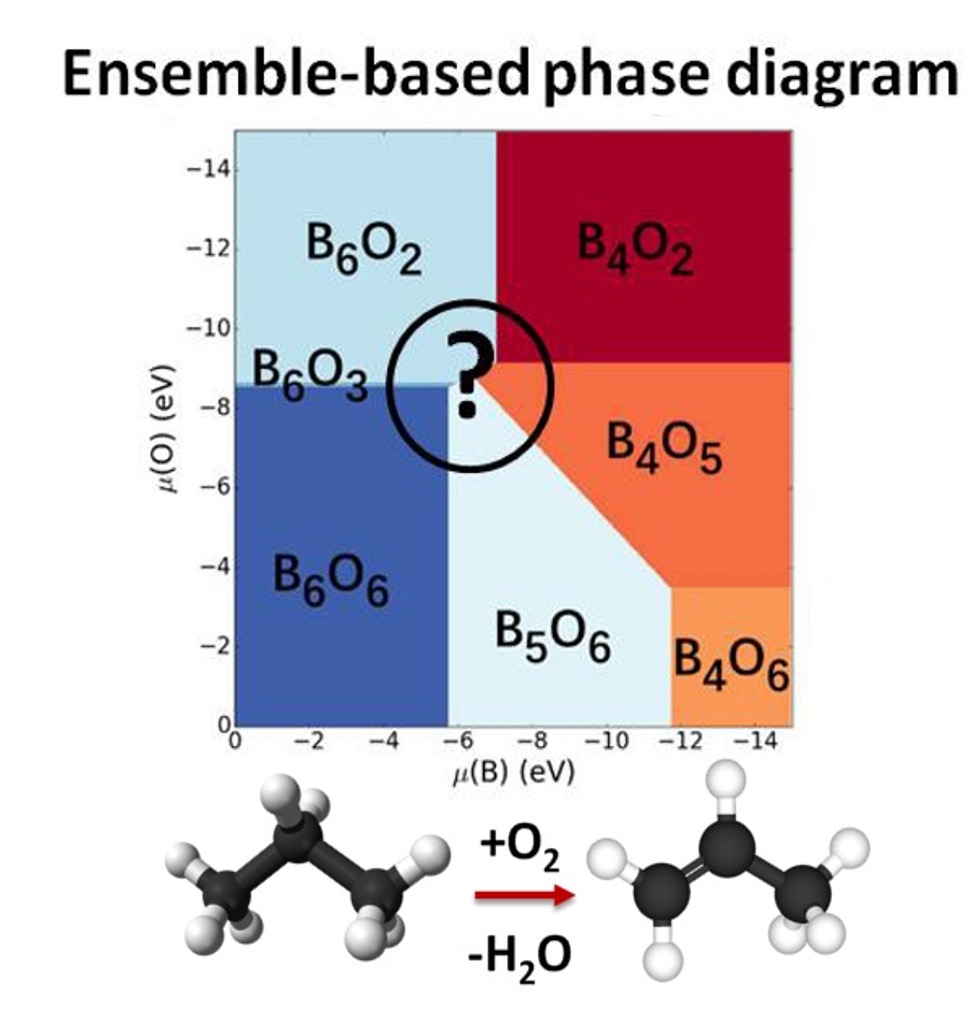
Venegas, J.; Zhang, Z.; Agbi, T.; McDermott, W.; Alexandrova, A. N.; Hermans, I. Why Boron Nitride is such a Selective Catalyst for the Oxidative Dehydrogenaiton of Propane. 2020, Angew. Chem. Int. Ed., VIP article, 14, 16527-16535. Download
Poths, P.; Vargas, S.; Sautet, P.; Alexandrova, A. N. Thermodynamic equilibrium versus kinetic trapping: thermalization of cluster catalyst ensembles can extend beyond reaction timescales. 2024, ACS Catal., 14, 5403-5415. Download
Poths, P.; Alexandrova, A. N. Theoretical perspective on operando spectroscopy of fluxional nano-catalysts. 2022, J. Phys. Chem. Lett., 13, 4321-4334. Download
Zandkarimi, B.; Poths, P.; Alexandrova, A. N. When Fluxionality Beats Size Selection: Acceleration of Ostwald Ripening of Sub-Nano Clusters. 2021, Angew. Chem. Int. Ed., 60, 11973-11982. Download
Li, G.; Poths, P.; Morgan, H. W. T.; Masubuchi, T.; Alexandrova, A. N.; Anderson, S. L. Got Coke? Self-Limiting Poisoning Makes an Ultra Stable and Selective Sub-nano Cluster Catalyst. 2022, ACS Catalysis, 13, 1533-1544. Download
Topological Catalysis
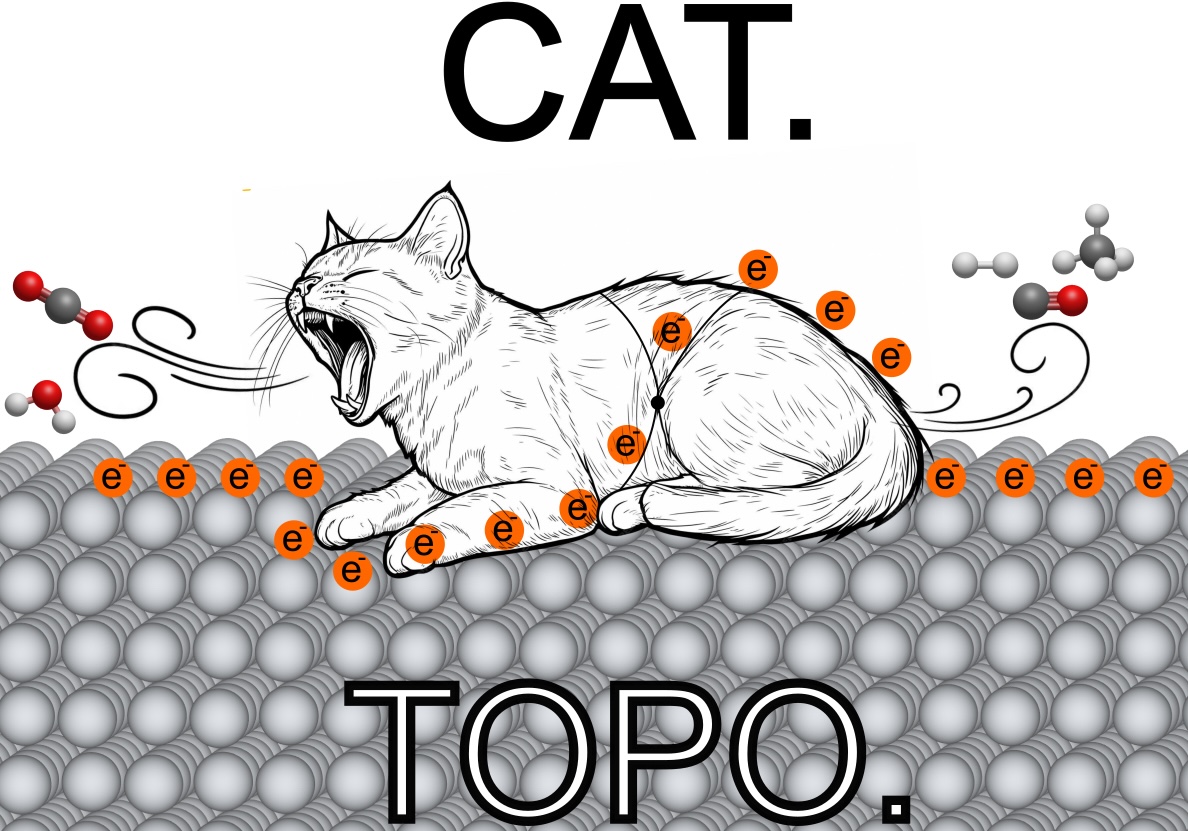
Topological materials are compelling targets for high-performance catalysis owing to protected surface and edge electronic states. Although promising applications have been reported for various topological insulators and semimetals, the catalytic mechanisms that distinguish them from conventional materials remain to be fully understood. We employ state-of-the-art computational approaches both to discover novel topological candidates and to elucidate the role of electronic surface states in catalysis. Outstanding questions include: (1) Are topological surface states robust under realistic reaction conditions? (2) How do these states evolve over the course of a catalytic cycle? (3) What is an optimal descriptor for topological catalysis?
Key Publications:
Weng, G.; Laderer, W.; Alexandrova, A. N. Understanding the Adiabatic Evolution of Surface States in Tetradymite Topological Insulators under Electrochemical Conditions. 2024, J. Phys. Chem. Lett., 15, 2732-2739. Download
Morgan, H. W. T.; Laderer, W.; Alexandrova, A. N. δ-bonding and spin-orbit coupling make SrAg4Sb2 a topological insulator. 2023, Chem. Eur. J., DOI: 10.1002/chem.202303679.
Weng, G.; Alexandrova, A. N. Understanding the Finite Size and Suface Relaxation Effects on the Surface States of Bi2Se3 Family Topological Insulator. 2024, J. Phys. Chem. C, 128, 20659-20669. Download
Laderer, W. T.; Jiang, X.; Vlcek, V.; Morgan, H. W. T.; Alexandrova, A. N. Topological perturbation to a standard dehydrogenation catalyst, Pt3Sn. 2025, Chem. Sci., DOI: 10.1039/D5SC02518D Download.
Weng, G.; Alexandrova, A. N. Unraveling the Surface Termination and Evolution of Surface States for Electrocatalyst PtSn4 in Alkaline HER. 2025, ACS Catal., 15, 10448-10458 Download.
Weng, G; Alexandrova, A. N. Bulk-Boundary Correspondence of Semimetal Ru3Sn7 and Topological Surface States on Chemically Realistic Terminations, Adv. Mater. Interfaces, 2025, accepted