
Quantum materials
We are interested in “molecular level” mechanisms behind quantum properties of materials, such as superconductivity, cdw, and topological properties. A chemists’ view onto those properties, such as deconvoluting the types of chemical bonds involved in the relevant bands, and types of vibrational motion and couplings that affect them, not only provides a deep insight, but also offers a path toward rational modification and material design.
Key Publications:
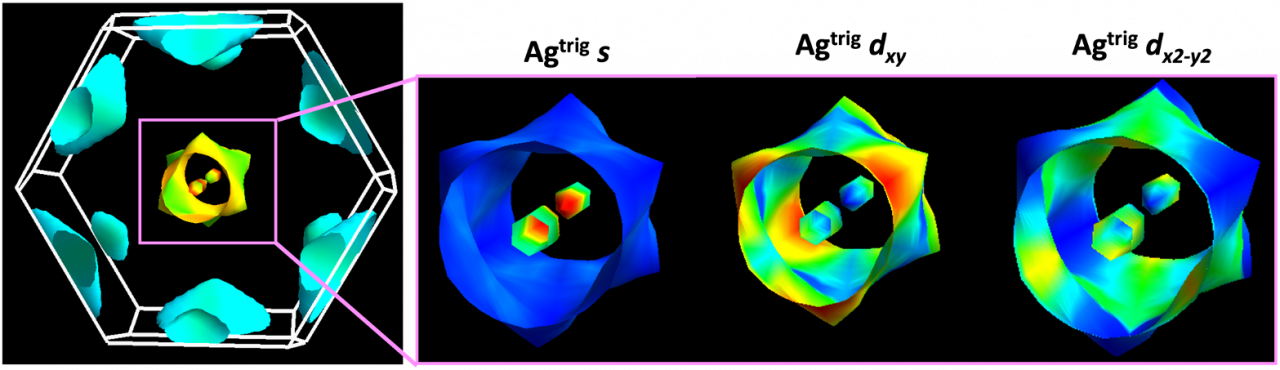
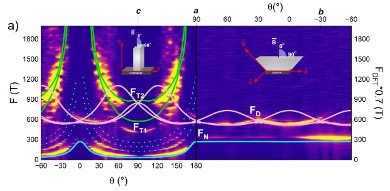
Green, J.; Morgan, H. W. T.; Mandigo-Stoba, M.; Gutierez, C.; Alexandrova, A. N.; Ni, N. Mapping the fermiology of the triangular lattice antiferromagnet EuAg4Sb2. 2025, Pys. Rev. B, 111, 085139. Download
Green, J.; Emmanouilidou, E.; Morgan, H. W. T.; Laderer, W. T.; Hu, C.; Loera, J.; Alexandrova, A. N.; Ni, N. Fermiology and transport properties of the candidate topological crystalline insulator SrAg4Sb2. 2024, Pys. Rev. Mater., 8, 054205. Download
Morgan, H. W. T.; Alexandrova, A. N. Structures of LaH10, EuH9, and UH8 superhydrides rationalized by electron counting and Jahn-Teller distortions in a covalent cluster model. 2023, Chem. Sci., 14, 6679-6687. Download
Lavroff, R. H.; Munarriz, J.; Dickerson, C. E.; Munoz, F.; Alexandrova, A. N. Chemical Bonding Dictates Drastic Critical Temperature Difference in Two Seemingly Identical Superconductors. 2024, Proc. Natl. Acad. Sci. USA, 121, e2316101121. Download
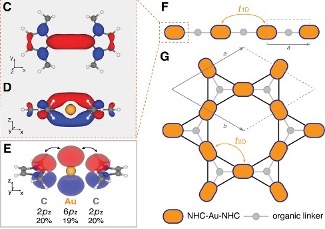
Qie, B.; Wang, Z.; Jiang, J.; Zhang, Z.; Jacobse, P.; Lu, J.; Li, X.; Liu, F.; Alexandrova, A. N.; Louie, S.; Crommie, M.; Fischer, F. Synthesis and Characterization of Low Dimensional N-Heterocyclic Carbene Lattices. 2024, Science, 384, 6698. Download
Robinson, P. J.; Munarriz, J.; Valentine, M. E.; Granmore, A.; Drichko, N.; Chamorro, J. R.; Rosa, P. F.; McQueen, T. M.; Alexandrova, A. N. Dynamical Bonding Driving Mixed Valency in a Metal Boride. 2020, Angew. Chem. Int. Ed., VIP article, 59, 10996-110022. Download
Topological Catalysis
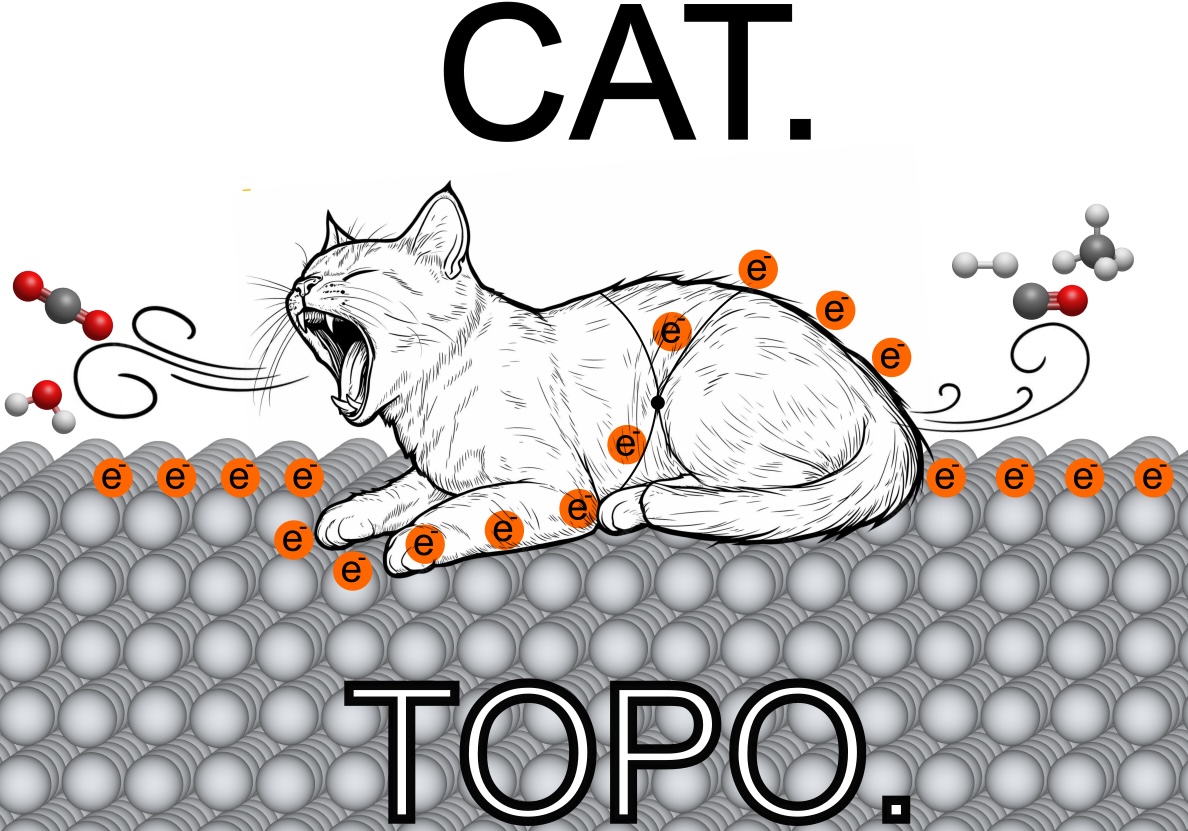
Topological materials are compelling targets for high-performance catalysis owing to protected surface and edge electronic states. Although promising applications have been reported for various topological insulators and semimetals, the catalytic mechanisms that distinguish them from conventional materials remain to be fully understood. We employ state-of-the-art computational approaches both to discover novel topological candidates and to elucidate the role of electronic surface states in catalysis. Outstanding questions include: (1) Are topological surface states robust under realistic reaction conditions? (2) How do these states evolve over the course of a catalytic cycle? (3) What is an optimal descriptor for topological catalysis?
Key Publications:
[1] Weng, G.; Laderer, W.; Alexandrova, A. N. Understanding the Adiabatic Evolution of Surface States in Tetradymite Topological Insulators under Electrochemical Conditions.2024, J. Phys. Chem. Lett., 15, 2732-2739. Download
[2] Morgan, H. W. T.; Laderer, W.; Alexandrova, A. N. δ-bonding and spin-orbit coupling make SrAg4Sb2 a topological insulator.2023, Chem. Eur. J., DOI: 10.1002/chem.202303679.
[3] Weng, G.; Alexandrova, A. N. Understanding the Finite Size and Suface Relaxation Effects on the Surface States of Bi2Se3 Family Topological Insulator.2024, J. Phys. Chem. C, 128, 20659-20669. Download
[4] Laderer, W. T.; Jiang, X.; Vlcek, V.; Morgan, H. W. T.; Alexandrova, A. N. Topological perturbation to a standard dehydrogenation catalyst, Pt3Sn.2025, Chem. Sci., DOI: 10.1039/D5SC02518D Download.
[5] Weng, G.; Alexandrova, A. N. Unraveling the Surface Termination and Evolution of Surface States for Electrocatalyst PtSn4 in Alkaline HER. 2025, ACS Catal., 15, 10448-10458 Download.
[6] Weng, G; Alexandrova, A. N. Bulk-Boundary Correspondence of Semimetal Ru3Sn7 and Topological Surface States on Chemically Realistic Terminations, Adv. Mater. Interfaces, 2025, accepted